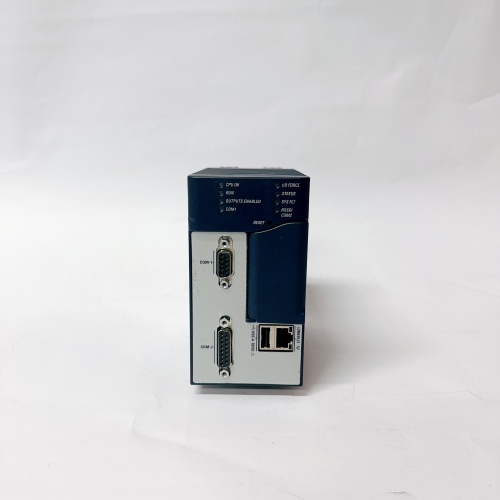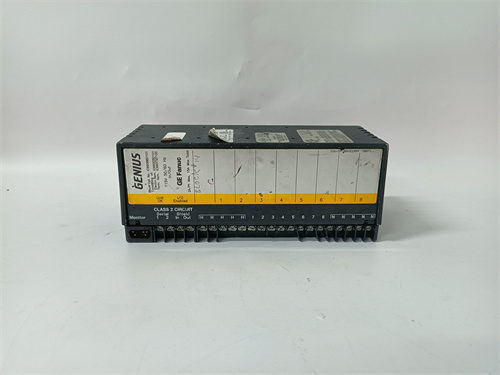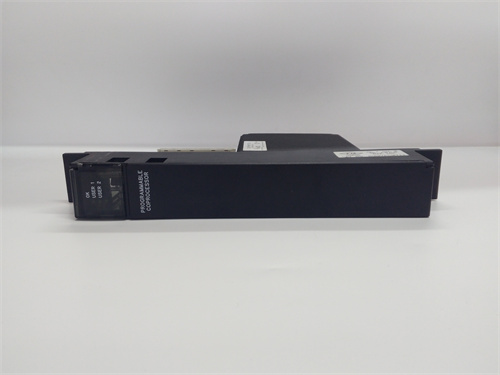
GE IC697VDD100 Module | Series 90-70 Discrete Input Card 16 Points
$ 96.54
Description Key Technical Specifications Parameter Specification Part Number IC697VDD100 Product Type Discrete Input Module Series Series 90-70 Input Channels 16 points (2 groups of 8) Input Voltage 24V DC positive logic Voltage Range 0-30V DC (10-30V DC = ON, 0-5V DC = OFF) Input Current 7 mA typical at 24V DC Isolation 1500V optical (group to backplane) Response Time 1 ms typical (OFF->ON and ON->OFF) Common Configuration 2 commons (one per 8-point group) Power Consumption 100 mA max from 5V backplane Indicators 16 green LEDs (one per input) Termination Front connector (40-pin) requires IC697CBL terminal strip Mounting Series 90-70 rack (any I/O slot) Condition New Surplus (Original Packaging) Product Introduction The GE IC697VDD100 is a 16-point 24V DC discrete input module for the Series 90-70 PLC platform. It accepts positive-logic field signals from pushbuttons, limit switches, proximity sensors, and other 24V DC devices. Each input is optically isolated from the backplane, and individual LEDs provide immediate visual status feedback. The IC697VDD100 organizes its 16 inputs into two groups of eight with common returns, simplifying field wiring. The module plugs into any I/O slot in a Series 90-70 rack and requires an external terminal strip (IC697CBL series) for field connections. This unit is new surplus, factory-sealed in original GE packaging. Series 90-70 components remain widely deployed; contact us for current stock and firm pricing. Frequently Asked Questions (FAQ) Q: What does “positive logic” mean for the IC697VDD100? A: Positive logic means the input turns ON when voltage is applied to the input terminal relative to the common. On the GE IC697VDD100, you connect the 24V side of your field device to the input, and the common (0V) to the module’s common terminal. Sinking sensors (NPN) that switch the negative side won’t work directly with this module—they require positive-logic (PNP) sensors or interface relays. This catches people switching from older PLCs that used negative logic. The IC697VDD100 expects to see 24V at the input. Give it ground, and it stays OFF. Q: Can I use the IC697VDD100 with 12V DC sensors? A: Technically yes, but reliability suffers. The IC697VDD100 specifies 10-30V DC as the ON range. At 12V, you’re right at the threshold. Voltage drop over long wiring can push you below 10V, causing intermittent ON/OFF flicker. If you have 12V sensors, either use a dedicated 12V input module or add interposing relays. In my experience, running the IC697VDD100 at 12V is asking for ghost faults at 3 AM. Stick to 24V for robust performance. Q: What’s the difference between and IC697VDD110? A: The is positive logic; the IC697VDD110 is negative logic (sinking). They look identical but are electrically opposite. Swapping them without changing field wiring guarantees every input reads backwards—ON when it should be OFF, OFF when it should be ON. Always verify your existing module’s part number. If your plant standardized on PNP sensors, you need . If you have NPN sensors, you need IC697VDD110. The modules are not interchangeable without rewiring. Q: Does the require external fusing? A: The module itself doesn’t have onboard fuses. Field power feeding the commons should be fused externally—typically a 2A or 3A fast-blow fuse per common group. If a field wire shorts to ground or another voltage, without a fuse you can fry PCB traces on the or damage the power supply. I always fuse each common group separately. It’s cheap insurance. The module can survive a short if the fuse blows first; without it, the module is sacrificial. Q: What cable do I need to connect field wires to the? A: The GE IC697VDD100 uses a 40-pin front connector that requires a transition cable and terminal strip. The standard mating cable is IC697CBL700 series—typically IC697CBL701 for 1-meter length or IC697CBL702 for 2-meter. These cables terminate in a IC697TBS terminal strip (screw terminals) that mounts on DIN rail. You don’t wire directly to the module; you wire to the terminal strip, and the cable carries signals to/from the . Never try to solder wires directly to the module connector—you’ll ruin it. Q: Can the accept inputs from two different voltage sources? A: Yes, because the has two isolated commons (one per 8-point group). You can run group A at 24V from one power supply and group B at 24V from another supply, or even different voltages within the 10-30V range. The isolation between groups is optical, so they can be completely independent. This is useful if you have sensors powered from different sources or need to segregate circuits for safety. Just don’t tie the commons together unless they’re from the same supply. Q: What’s the typical failure mode for these modules? A: Input optocouplers fail from surges. The has 1500V isolation, but lightning nearby or welding on plant structures sends spikes through field wiring. You’ll lose one or two inputs while the rest work fine—classic surge damage. Second: the 40-pin connector makes intermittent contact after years of vibration and thermal cycling. If you have random “input missing” faults that move when you reseat the module, the connector pins may be corroded or loose. Clean with contact cleaner and reseat firmly. If that fails, replace the . The module itself is solid, but connectors age. Q: Can I hot-swap the in a running Series 90-70 rack? A: No. Never hot-swap I/O modules in Series 90-70 systems. The backplane distributes power to all slots simultaneously. Pulling a live can arc the connector pins, damage the backplane, or cause the CPU to fault. Always power down the rack before removing or inserting any module. Series 90-70 wasn’t designed for hot-swap. If you need redundancy, you need a different architecture. For maintenance, schedule a brief outage. It’s faster than repairing a damaged backplane. Q: How do I know if my input problem is the module or the field device? A: First, look at the LEDs on the . If the LED is ON when the field device is supposed to be ON, the module sees voltage—problem is upstream (sensor, wiring, or logic). If the LED is OFF when it should be ON, measure voltage at the input terminal (at the terminal strip, not the module). If you have 24V at the terminal but the LED is OFF, the input circuit is likely dead. If you have no voltage, trace back to the sensor. In my experience, 80% of “bad input module” complaints turn out to be wiring or sensor failures. The is usually innocent until proven guilty. SPAM150C IC693TCM302B PLC IC693APU302 PLC 6ES5095-8MB03 (PLC) 499ACL-01-54 PLC 1056-01-21-38-HT PLC FBM215-P0922VU PLC FBM218-P0922VW Email: [email protected] Phone: 86 15340683922 Sales:Wu Jiedong Our products are guaranteed for 1 year, with new and original production stopped and imported spare parts. All prices listed on the official website are subject to confirmation by contact: Wu Jiedong (manager). Our product: brand new original packaging Our warranty: All new or repaired parts have a 12 month warranty period beginning Our payment: 100% telegraphic transfer of inventory items before shipment, conditions can be proposed! If you have any downtime spare parts that you cannot find, please feel free to call or use email to contact me. If there are issues that the product cannot solve, please contact me. Product prices can be negotiated. Please do not consider contacting me!